
Choosing Waterproof Boots for Muddy Coastal Trails
The Coast Is Never Finished
Walkers often talk about the coast path as though it were a fixed thing — a line drawn on a map, a set of steps and stiles you can rely on year after year. It isn't. Around 4,000 miles of coastline ring these islands, and every tide, every gale and every heavy spell of rain rearranges a little of it. Some of that change is imperceptibly slow. Some of it happens in a single night.
The pace depends on what the cliffs are made of. The soft glacial till of the east coast — those crumbling boulder clay slopes in Yorkshire and Norfolk — can retreat by several metres in a bad winter. The chalk of Kent, Sussex and Dorset shifts in great slab-like falls. Even the granite of the far south-west, which looks eternal, sheds blocks and develops gullies. Hard rock erodes slowly; soft rock erodes quickly; both erode. Understanding that is the first step to walking the coast well.
Warning Signs at the Edge
You do not need to be a geologist to read a cliff. The ground usually tells you what it is about to do, often days or weeks in advance. Before you lean over anything for a view, look down.
- Cracks in the turf running parallel to the cliff edge are one of the most reliable signs of imminent collapse. The gap between crack and edge is the part most likely to go.
- Undercut lips — where you can see daylight beneath the grass, or the top overhangs a hollowed-out base — mean the supporting rock has already gone.
- Fresh soil, stones or rubble on otherwise clean grass suggests recent movement nearby.
- Fallen or leaning fencing is rarely just vandalism. Fence posts are usually set well back from the edge because the ground they stood on has disappeared.
- Tilted waymark posts and sagging gates can indicate the ground itself is creeping.
- Sinkholes and damp hollows in a cliff-top field may mark where water is finding a way through.
If any of these appear, the correct response is simple: keep back, and keep further back than feels necessary. Ten metres is a reasonable minimum on an unstable cliff top, and more after rain.
What Storms Leave Behind
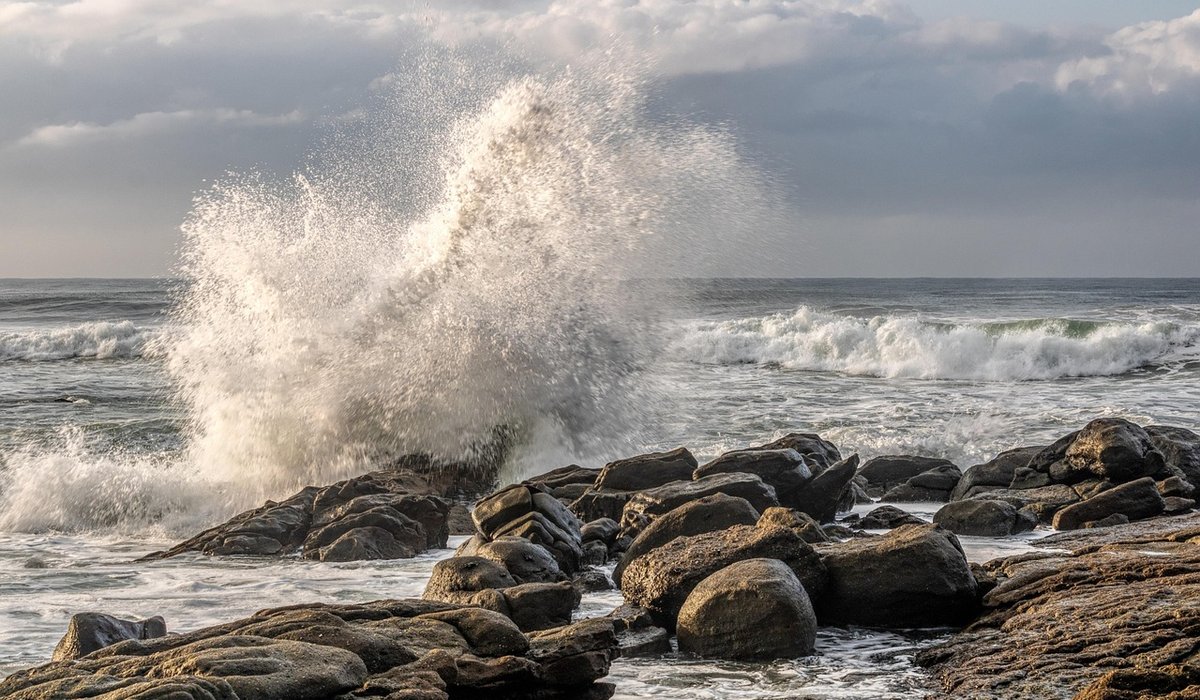
Most serious erosion happens in clusters. A deep low-pressure system brings a surge that lifts the sea above its usual level, while waves attack the base of the cliff and rainwater soaks the top. When the base is cut away and the top is heavy with water, whole sections can slide — sometimes as a rotational slip, where a great curved block drops and tips backwards, leaving a jumbled shelf that looks deceptively solid.
After a storm, the coast path can be damaged in places that were perfectly sound the week before. Steps vanish, boardwalks hang in mid-air and sections of path are left as narrow ribbons on a steepening slope. Walk gently on any newly exposed surface; freshly slipped ground takes a long time to settle.
Reading a Diversion Properly
Diversions are not suggestions or inconvenient bureaucratic fuss. When a path is officially moved inland, it is usually because the original line has become genuinely unsafe, or because the landowner and the highway authority have agreed a new route after the old one collapsed into the sea.
Follow the waymarks, even when the old route looks passable. A short detour through a field or along a lane adds minutes; an illegal shortcut across a slipping cliff face can add considerably more risk. Where a diversion follows a road, treat it as a road walk: walk on the right-hand side where it is safer to do so, keep together at blind bends, and wear something visible in low light. If a path is closed outright, it is closed for a reason, not to be ignored because the closure is not convenient.
Heritage That Slips Away
Erosion takes more than footpaths. Along our shores are the remnants of centuries of maritime life: the footings of lime kilns, the walls of coastguard cottages, the stubs of chapels, quays and jetties, and pillboxes from more recent conflicts. When a cliff retreats, these go with it, and often without record.
If you notice a newly exposed wall, a scatter of dressed stone or fragments of pottery or brick on a beach, note the location and pass the information to your local historic environment record or museum. Never dig into a cliff face or remove material — it is unstable, and in some cases protected by law. Photographs with a clear location are genuinely useful; souvenir-hunting is not.
Habits That Keep You and the Path Safe
- Check tide times as carefully as you check the weather, and give yourself more time than the walk suggests.
- Stay on the marked line on cliff tops and never approach an edge to photograph it.
- Avoid sitting directly beneath cliffs, especially after rain or a big tide.
- Walk with someone where you can, and tell someone your route and expected finish time.
- Turn back without embarrassment if the ground is crumbling or the sea is surging.
- Report damage, fallen signs or new cracks to the relevant path authority so others are warned.
The coast is one of the finest places in Britain to spend a day, and it rewards attention. Read the ground as carefully as you read the view, and you will walk it for years to come.
LEAVE A COMMENT